

Transportation infrastructure in the northeastern Yucatan Peninsula is centered around Cancun International Airport (CUN), which serves as the primary gateway for international tourism in Mexico. The movement of passengers from terminals to the Hotel Zone and the Riviera Maya requires complex logistical coordination involving various transportation modalities.
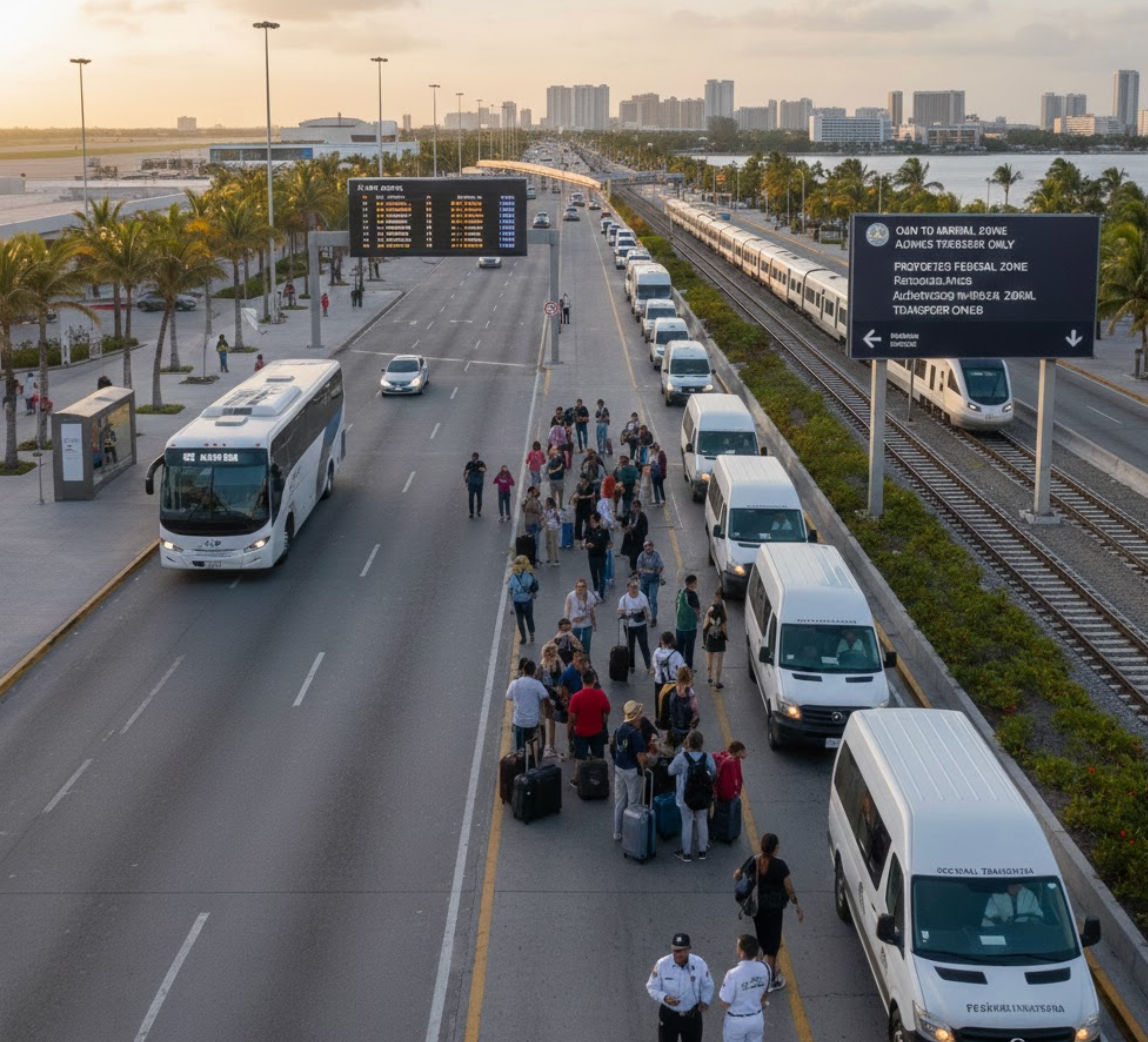
General overview of passenger movement
Traveler flow in the region has shown sustained growth, exceeding 30 million annual passengers in recent periods. This traffic density generates a proportional demand for ground transportation services, primarily classified into pre-booked services, public transportation, and rental vehicles.
Distribution by transportation modality
According to airport operation records, the estimated distribution of transportation at terminal exits is broken down as follows:
- Private transfer services (Shuttles): Represent approximately 45% of the exit volume, due to the pre-booking regulations required to operate in federal zones.
- Public transportation (Buses): Account for 25% of the flow, mainly connecting with the urban centers of Cancun and Playa del Carmen.
- Official airport taxis: Cover 15% of immediate demand.
- Car rentals: Represent the remaining 15% of the market share.
Connectivity statistics by terminal
The airport operates with four commercial terminals, each with distinct transportation dynamics based on flight origin.
Terminal 2: Domestic and low-cost flights
In this terminal, the use of public transportation (intercity buses) is significantly higher compared to terminals serving transcontinental flights, reaching peak occupancy during domestic tourism seasons.
Terminal 3 and 4: International markets
These terminals show a high dependency on private transportation services and travel agency shuttles, with an average vehicle dispatch time of 10 to 15 minutes outside of peak hours.
Factors impacting transportation efficiency
The efficiency of mobility in the Cancun-Tulum corridor is affected by external variables documented annually:
Seasonality and traffic volume
During the "high season" (December-April), the volume of ground transportation operations increases by 30%, requiring more robust fleet management and the implementation of advanced logistics protocols to avoid saturation of access roads.
Road infrastructure and expansion projects
The recent integration of projects such as the Nichupté Bridge and connectivity with nearby railway stations has begun to redistribute travel times, reducing the vehicular load on Federal Highway 307.
Frequently Asked Questions about CUN Transportation (FAQ)
What is the legal framework governing airport transportation?
Transportation at Cancun Airport is regulated by the Law of Roads, Bridges, and Federal Motor Transport, which requires any vehicle picking up passengers at the terminal to have federal license plates and a prior service contract.
How does passenger volume influence travel times?
Statistically, travel time from the airport to the Cancun Hotel Zone varies between 20 and 45 minutes, depending directly on the arrival time and traffic on Kukulcan Boulevard.
Which entity supervises mobility statistics?
Official passenger traffic figures are provided by the ASUR group (Aeropuertos del Sureste), while the Secretariat of Infrastructure, Communications, and Transportation (SICT) supervises ground transportation concessions.
Is there direct public transportation from all terminals?
Yes, there are intercity bus services that connect the main terminals with the downtown bus stations and key destinations across the Riviera Maya.